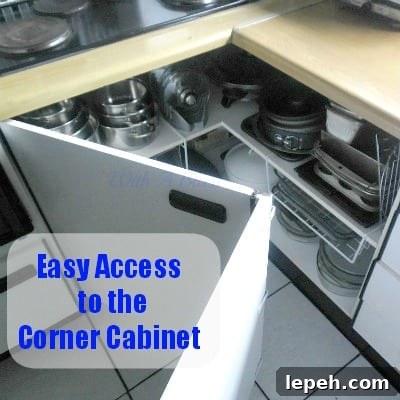
Open up the kitchen corner cabinet – easily create access to that awkward corner with a simple trick
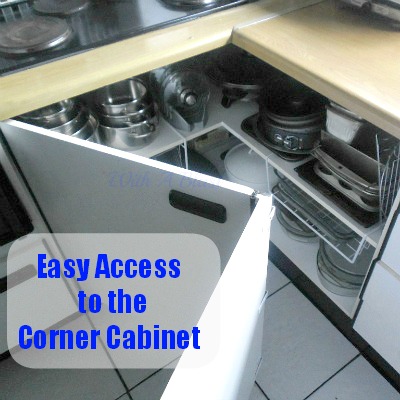
We’d been focused on the lounge for a while, but recently turned our attention to the kitchen for a small project or two. Many of us have faced the familiar corner cabinet problem: two cabinets meet and you either lose usable space or can’t reach what sits in the very back. In my case, both issues were present—items were lost to dead space and were hard to access.
This irritation lasted for years, but it’s finally solved and it only took a couple of hours. This post is photo-heavy, so I’ll keep the text focused and practical.

The BEFORE shot shows that we’d already removed the door on the right cabinet and taken out the small plank that closed the gap between the two cabinets. There was a hidden gap I hadn’t even noticed.
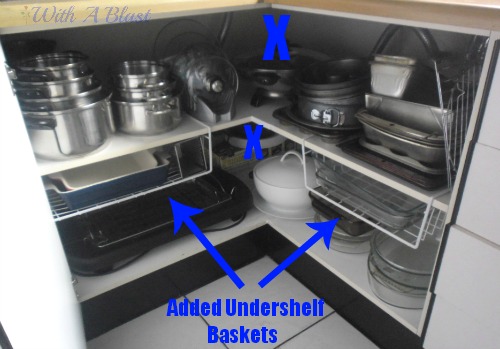
As they say, X marks the spots where items were tucked in the back and difficult to remove.

Almost everything in that corner was hard to reach.

Here you can see the gap we discovered when the front plank was removed.

With the right door removed, we started cutting back the dividing walls. Both side walls between the cabinets were removed to create a continuous space.

We inserted small filler planks on the bottom shelf and the upper shelf to join the two cabinets together. To move the right cabinet closer, my husband temporarily shifted the drawer cabinet and even removed the countertop. These filler planks create a continuous shelving surface between the cabinets.
Because removing the side walls weakened the structure, we added hidden support planks underneath the countertop and shelves. These braces are out of sight but keep the joined cabinets sturdy and stable.

This is the simple, clever part: we joined the two original doors with three L-brackets to form one large L-shaped door. The original door hinges were removed and the two doors now operate as a single unit.

Here’s a clearer view of the filler planks that create continuous shelving between the cabinets.

One more shot showing how the internal supports were fitted. It’s straightforward and effective.

We now open the cabinet from the right side only; the left door remains in place cosmetically so it still reads like two separate cabinets. Functionally, the two cabinets are one joined space with a single, L-shaped door.
Closed view. Note the pull-out drawer under the oven at eye level on the far left—I’ll show how that relates to the new layout below.

Open and repacked: I added under-shelf baskets to make the most of the space. Several items were relocated—plastic containers moved to a new spot, and pots that used to sit in the pull-out drawer are now stored in the joined cabinet along with their lids on a dish rack.
Items marked as less frequently used can stay in the back corner since they’re still reasonably reachable. This keeps frequently used items accessible while making good use of the previously wasted space.

The pull-out drawer now holds pans and lids. The new L-shaped door opens around this drawer without interfering with its function.
After a few simple cuts, filler planks, hidden supports and a couple of brackets, years of frustration are gone. The corner is now accessible, organized and much more practical—proof that a small, thoughtful modification can make a big difference in daily kitchen use.
LINDA
~~ Quick PIN Link ~~
Open Up The Kitchen Corner Cabinet
