Namibia takes its name from the Namib Desert, one of the oldest deserts on Earth at roughly 80 million years old. The name means “Open Spaces,” which is fitting for the country: Namibia is the second most sparsely populated nation after Mongolia, home to about 2.3 million people across a landmass nearly twice the size of California. Located in southwestern Africa, Namibia borders Angola to the north, Botswana and Zambia to the east, and South Africa to the south, while a long western coastline meets the cool South Atlantic Ocean.
The coastline, known as the Skeleton Coast, is famous for its dense fog where cold Atlantic waters meet the warm desert air. Portuguese sailors of the 15th century called it “The Gates of Hell,” and local San communities refer to it as “The Land God made in anger.” The name Skeleton Coast also reflects the many animal graveyards and shipwrecks scattered along its shores; human remains are sometimes found there as well.
Today the Skeleton Coast is protected as a national park, marked by gates bearing skull and crossbones. The park is divided into northern and southern sections. The northern area is largely inaccessible and home to the Himba people, the country’s last nomadic herders. Access to this region is limited—only a small number of tourists are allowed each year. The Himba live in mud huts and rely heavily on meat. Women traditionally coat their skin with a mixture of butterfat and ochre, a pigment rich in ferric oxide, producing a characteristic reddish glow that helps protect against the sun. They also wear distinctive ankle bracelets to guard against venomous creatures. The Himba have traversed the Skeleton Coast for generations.
Beyond the human inhabitants, the Skeleton Coast and surrounding regions support remarkable wildlife. Desert-adapted elephants maneuver down sand dunes; these animals are not a separate species but have adapted physically to the arid environment, with only an estimated 600 desert elephants remaining. Conservation organizations are active in protecting them. Giraffes, lions, zebras, hyenas and black rhinos also populate the region. One coastal area hosts a colony of about 250,000 Cape fur seals. The coastal dunes are one of the few places on Earth where the “roaring dunes” phenomenon occurs: when wind and sand grains interact they can produce a deep rumbling sound. The Namib Sand Sea is recognized as a UNESCO World Heritage Site, as is Twyfelfontein, an open-air rock art gallery containing over 2,000 engravings dating back some 6,000 years.
Namibia also features other protected and heritage sites. The Fish River Canyon in the south is one of the largest canyons in the world, second only to the Grand Canyon. The Quiver Tree Forest in southern Namibia contains around 250 specimens of a tree-like aloe known locally as the quiver tree. Indigenous San people historically used its hollowed branches to make arrow quivers. Some of these trees reach impressive heights and are believed to be between 200 and 300 years old.
Etosha National Park in the north is Namibia’s premier wildlife sanctuary and a major destination for safari visitors. Another top attraction is Sossusvlei, known for its towering red sand dunes that surround a salt and clay pan. Some of these dunes—like the famous “Big Daddy”—rise to nearly 400 meters, offering dramatic desert landscapes.
Namibia became independent from South Africa on March 21, 1990. Prior to that, Germany colonized the territory in 1884, and South Africa administered it after World War I. Since independence, Namibia has transitioned from minority apartheid rule to a democratic government.
The population is ethnically diverse, with about 11 main groups. Roughly 60 percent of people live in the northern regions; the southern and coastal areas remain sparsely populated due to the harsh environment. The Ovambo are the largest ethnic group. The San (or Bushmen), believed to be the earliest inhabitants, are known for their distinctive click languages. English is the official language, though many people speak their own tribal languages; German influence remains visible in architecture and place names, and some German speakers still live in Windhoek and smaller towns.
Namibian cuisine reflects South African, German and indigenous influences and is often regionally specific, depending on local ingredients. Pap, a corn or millet porridge whose name comes from Dutch, is a staple carbohydrate usually served with flavorful sauces or vegetables. Cattle and sheep typically graze on savannah grasses and shrubs and are raised without antibiotics or hormones. Game meats—venison, ostrich, springbok, gemsbok, and crocodile—are common, as is seafood. Oysters are available year-round and highly prized. Braaivleis, a style of barbecue, is the traditional way of cooking meat. Potjiekos, a spicy stew cooked slowly in a three-legged cast-iron pot over an open flame, often includes meats such as chicken or fish.
Kapana, also spelled kampana, is popular street food made of freshly grilled meat dipped in chili powder and served with a tomato and onion salsa; it’s considered an effective hangover cure. Beer brewed locally by NamBrew follows a traditional Bavarian purity law and has won international recognition. German desserts such as Schwarzwälder Kirschtorte (Black Forest cake) and Apfelstrudel are loved, while South African specialties like biltong (dried meat) and droëwors (dried sausage) are everyday snacks. Local delicacies include swakopmund asparagus, Kalahari truffles, and majawa mushrooms, the latter emerging briefly at the bases of termite mounds after seasonal rains in February.
Kalamata-style black and green olives are cultivated in Namibia, and a variety of cheeses are produced near Otjiwarongo. Mopane worms—actually caterpillars—are a traditional specialty of the Owambo people: harvested in the north and fried until crispy, they are a protein-rich seasonal treat.
Below is a sample Namibian menu to illustrate the country’s flavors.
The Menu
Starter
Kapana (Beef with Sauce, a Street Food)
Main Course
Boerewors (Sausage)
Served with Pap (Cornmeal Porridge) and Fried Cabbage
Dessert
Fat Cakes (Fried Dough)
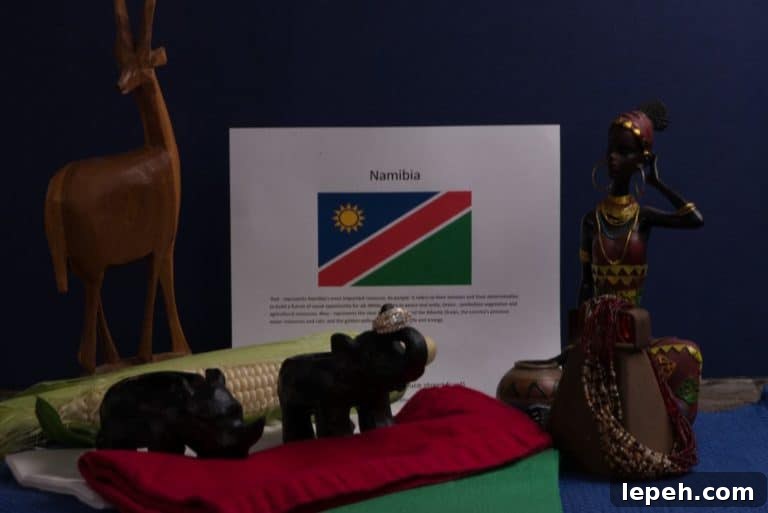
Our table setting included symbols of Namibia: representations of free-roaming cheetahs and black rhinos, an oryx to represent the national animal, diamonds to reflect the country’s mining history, corn for the staple pap, a cowbell for the importance of beef, and the national flag with its bright sun symbolizing life and energy.
We began the meal with local beer and kapana—charcoal-grilled grass-fed beef cut into bite-sized pieces, seasoned with chili and salt, then combined with a fresh mix of tomatoes, onions, chili, oil and vinegar. The flavors were bold and satisfying, and it’s easy to understand why kapana is a beloved street food in Namibia.
Dining in Namibia is often communal and traditionally done with the right hand. Our main course arrived together: boerewors, a handmade sausage of beef and pork seasoned with crushed coriander, clove and nutmeg with a touch of brown sugar and vinegar, grilled over coals in true braaivleis fashion. It was paired with pap and a savory fried cabbage dish with caramelized onions and turmeric. The combination of smoky, spiced meat and comforting sides was delicious.
For dessert we enjoyed fat cakes: rounds of fried dough, crispy outside and tender inside. They can be served plain, dusted with sugar or spread with jam; ours were lightly sprinkled with sugar and were a delightful finish to the meal.
Before leaving Namibia, here are a few proverbs that capture local wisdom:
“A diamond’s father is coal, yet it regards itself as upper-class.”
“Elephants carry each other.”
“Envy and greed grow on the same stalk.”
“The earth is not ours; it is a treasure we hold in trust for future generations.”
p.s. Namibia was the first country to include environmental protection in its constitution.
Until next time,
Warmest regards,
Darlene